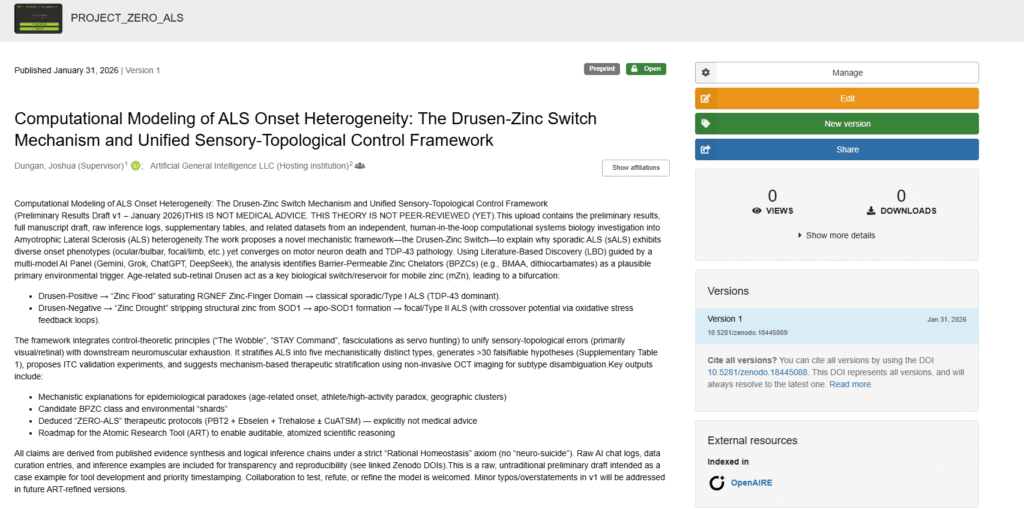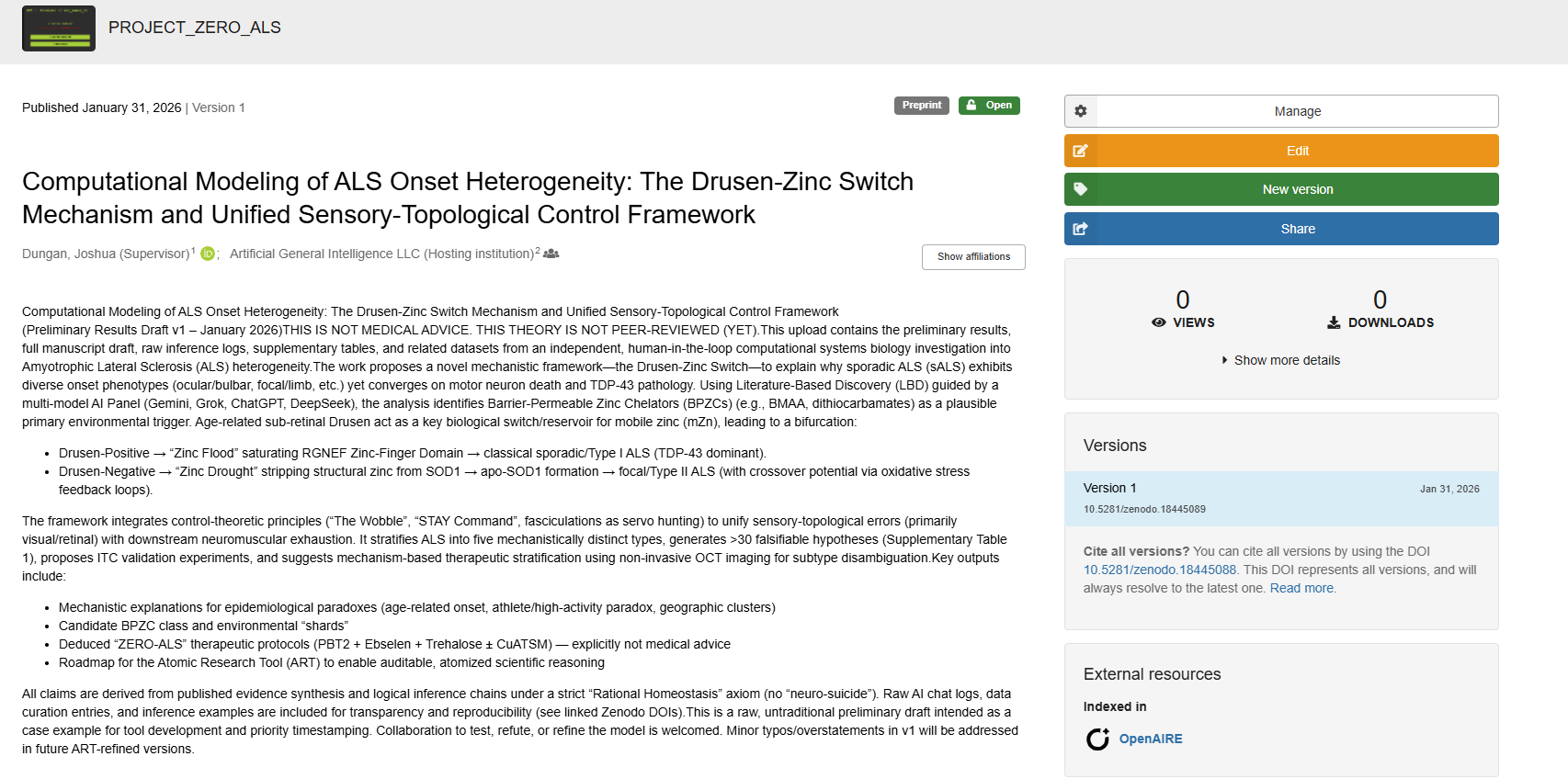
Disclaimer: THIS IS NOT MEDICAL ADVICE. THIS THEORY IS NOT PEER REVIEWED (YET).
Computational Modeling of ALS Onset Heterogeneity: The Drusen-Zinc Switch Mechanism and Unified Sensory-Topological Control Framework
Disclaimer: THIS IS NOT MEDICAL ADVICE. THIS THEORY IS NOT PEER REVIEWED (YET).
This is the preliminary result and dataset that attempts to disambiguate ALS using deductive reasoning, inference logic, anecdotal gap analysis, and statistical reasoning. This is a Preliminary Results Draft (v1) – Case Example for Atomic Research Tool Development (See the Roadmap for the Atomic Research Tool and Final Note near the end of the document for more details).
Author: Joshua Dungan
Collaborator: Laura LaVene
Date: January 31, 2026
Affiliation: Artificial General Intelligence LLC (Grand Rapids, Michigan, 49508, USA) [https://artificialgeneralintelligence.llc]
ORCID iD: 0009-0005-0962-8456
Contact: mailto:admin@artificialgeneralintelligence.llc
Zechariah 3:9 “For behold, the stone that I have set before Joshua, on a single stone with seven eyes, I will engrave its inscription, declares the Lord of hosts, and I will remove the iniquity of this land in a single day.”
For Dan Doctoroff, #everyoneLives …
Author’s Foreword
As a non-medical person having never taken an anatomy class—a PHP developer and independent researcher based in Grand Rapids, Michigan—the author collaborated with AI tools to synthesize literature, challenge assumptions, and refine the systems models presented here. Every claim has been manually reviewed (see https://doi.org/10.5281/zenodo.18444677 for logs) for alignment with published evidence. The aim is to generate testable hypotheses that may contribute to ALS stratification, early biomarkers, and subtype-specific therapies. Collaboration to validate or refute these ideas is welcomed.
Please remember, this is not intended to present as a theory ready for review, since it is my raw dataset that I am building to print an unassailable paper to show that ocular insults are a key upstream indicator. The paper is “untraditional” and this is not unintentional as I need to train the AI models to know what “not to do” (e.g., personal comments like this and the following Origin Story – though true, do not belong in a formal work such as an ALS disambiguation paper).
Author’s Note: Origin of the Inquiry
I began to research ALS on June 16, 2025 after watching Eric Dane’s ALS interview at around 3AM, inspired by a moment when therein I heard an external (unseen) voice – whom I call the Creator – say to me “It started in his eyes.”.
I have never even taken an anatomy class, but instead, I am a fact-checker by trade and a PHP-hobbyist. Contrary to the advice of the AI model panel, I include that I give glory to the one whose voice has led me, and pray for peace and healing for all. Give glory to God and pray that this works.
Abstract
Background: Amyotrophic Lateral Sclerosis (ALS) presents with heterogeneous onsets—focal limb weakness, bulbar dysfunction, respiratory insufficiency, or generalized decline (e.g., rare, diffuse onset)—yet converges on a specific pattern of motor neuron death [1] and widespread TDP-43 pathology [2]. Current models fail to fully reconcile why distinct onset sites lead to the same terminal pathology, or why sporadic ALS (sALS) is strongly age-correlated while familial cases display distinct temporal profiles.
This study applies a computational systems biology approach to derive a mechanistic basis for ALS stratification and provides a plausibly consilient table of falsifiable hypotheses generated and/or allowed within the framework. Notably, this study provides a potential disambiguation of ALS subtypes at/near onset using non-invasive technology with high accuracy potential.
Methods: I utilized a Literature-Based Discovery (LBD) human-driven prompting protocol with a Multi-Model Adversarial AI Consensus (hereafter, “AI Panel” or “Model Panel”). The AI Panel was used to provide me with evidence suggestions, explanations, and source urls to review (e.g. Pubmed links) and analyze. I guided my research prompts so that the AI would consider both connections and disjunctions within biomedical corpora (Ophthalmology, Toxicology, Neurology, Metallobiology, etc.). Typically, when asking the AI Panel if ALS can be ocular induced, the response will inevitably refer to current research which poses ALS as a motor neuron first, and not ocular induced. However, the inference chains easily guide the AI Panel to consider the potential connection (See Inference Chat Example 1).
Protocol A (Topological Mapping) synthesized control-theoretic principles with the genotypic-phenotypic dataset from Schmitt et al. (2025) (n=237 genetic subcohort) to stratify onset patterns, which I then hypothesized to the AI about what the data might imply.
Protocol B (Inference Chain Analysis) became refined throughout the evidence-led process to ultimately utilize a Constraint Satisfaction Protocol (that is, I required the AI to require that the brain cannot be “suicidal”, but rather, it seeks homeostasis) and ended up leading to a predominant variable to solve for—Retinal Zinc Homeostasis (its role in ALS). I utilized conversational prompts with free AI chatbots and I designed the prompts to elicit scientific evidence and factual explanations from the model panel, challenge the findings, and document potential correlations. The collective responses were iteratively considered, which led to observed plausible explanations for several epidemiological paradoxes and unanswered questions (e.g., “Age-Related Onset”, “Athlete/High-Activity People Paradox”, “Geographic Clusters”) without contradiction.
Results: The computational analysis derives a core mechanistic bifurcation—the Drusen-Zinc Switch—in which age-related sub-retinal deposits (Drusen) may act as a likely pathological reservoir of mobile zinc among other factors. This literature based discovery study (the outcome) predicts that in older adults, a class of Barrier-Permeable Zinc Chelators (BPZCs) encompassing both lipophilic agents and hydrophilic transport mimics triggers an age-dependent “Zinc Flood” from these stores, disrupting zinc-finger proteins (RGNEF) and precipitating TDP-43 pathology (Type I-A & I-B / Classical Sporadic ALS).
Uniquely, the absence of a Drusen “reservoir” could allow for a “Zinc Drought” wherein the BPZCs may strip structural zinc from SOD1 creating apo-SOD1, a known marker in ALS (Type II / Focal Onset). This study predicts that with a lack of drusen, but with the presence of BPZCs, apo-SOD1 could be created in the retina, creating at least one crossover potential into sporadic ALS or Focal ALS. The first crossover potential we predict is that the BPZCs responsible for retinal apo-SOD1 formation could initiate the Type I “Zinc Flood”. Since recent studies demonstrate that Copper (Cu) causes oxidative stress on retinal ganglia and TDP-43, our study/framework implies that if a patient mounts a natural Mobile Zinc (hereafter, mZn) response to ocular apo-SOD1 induced oxidative stress, this compensatory mZn becomes available for chelation by the BPZC, potentially resulting in a sporadic onset pathology via RGNEF Zinc Finger Domain disruption, despite having no Drusen as a zinc source to draw from.
Key Outputs: The result of the computations generated over 30 hypotheses (Supplementary Table 1), proposed ITC experiments (Section 6.4), a plausible solution for the “Bad Test Grouping” problem with therapeutic implications [NOT MEDICAL ADVICE] (Section 5 [NOT MEDICAL ADVICE]), and a parsimonious stratification of ALS into five types. Excitingly, the data suggests that a non-invasive OCT scan may potentially be useful as a non-invasive way to deduce if the patient has truly sporadic ALS (e.g., “ocular induced”) or truly Focal onset – while Bulbar onset is clearly different (and we identified at least one gap in “wet-lab” research that may show it to be related to cochlear and/or Scarpa’s ganglion) – and Familial ALS having the c9orf72 markers and a retinal marker similar to what is seen in FTD and rather than sporadic ALS (this leaves a good start for disambiguation) – leaving the “injury/trauma induced” to consider separately and jointly.
Conclusion: The framework identifies Barrier-Permeable Zinc Chelators as a plausible primary environmental trigger for Sporadic ALS pathology with onset phenotype likely influenced by the presence or absence of Drusen (with regard to Sporadic ALS) among other factors. The framework concludes that, within the boundaries of the scientific evidence considered, the brain and retina relationship (sharing cellular structure and evolutionary adaptation) is not separate from, but rather, directly connected to sporadic ALS pathology onset. Due to the coherence of the hypotheses generated by the framework, we invite the ALS research community to evaluate this framework against existing data and welcome collaborative efforts to test, refine, or refute the proposed model.
Keywords: ALS, Computational Systems Biology, Drusen-Zinc Switch, State Estimation, TDP-43, BMAA, Dithiocarbamates, Literature-Based Discovery
Disclaimer: THIS IS NOT MEDICAL ADVICE. THIS THEORY IS NOT PEER REVIEWED (YET).